Gold Signals Explained: Reading an XAUUSD Setup
You receive a gold signal, open your broker's chart and find that the price has already moved. Should you still enter? The message alone cannot answer that. You need to compare the original setup with the trade available in your account now.
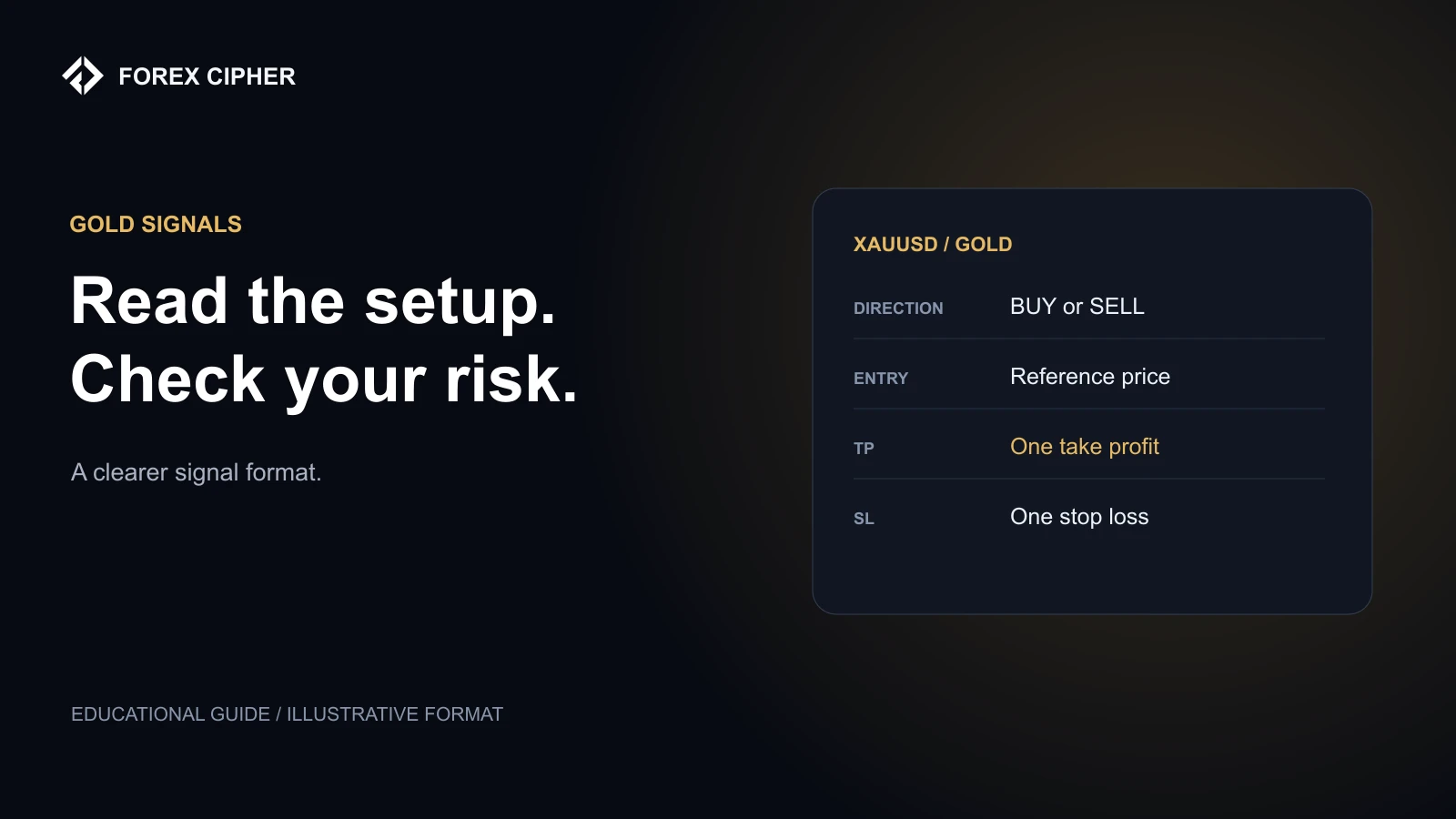
Forex Cipher's Gold Signals focus on XAUUSD. Each setup has a direction, an entry, one take profit and one stop loss. The format has no second target and no instruction to take half the position off at an intermediate level.
What XAUUSD means
XAU is the symbol for gold and USD is the US dollar. In a typical XAUUSD quote, the displayed price represents dollars per troy ounce. The position you place, however, follows your broker's contract specifications. Check those specifications rather than assuming a gold lot behaves like a currency-pair lot.
Broker symbols can also differ. A suffix or an alternative symbol name is worth checking before you copy any price into an order ticket.
Read the entry, TP and SL together
Illustration only: the following prices are invented. They are not a live recommendation or evidence of performance.
XAUUSD BUY: 2400.00
TP: 2410.00
SL: 2395.00
The target is $10 above the reference entry and the stop is $5 below it. Those are price distances, not the amount of money your account will gain or lose. Account profit or loss also depends on trade volume, contract size, currency conversion and costs.
The reference reward-to-risk ratio is 2:1 before costs. If your fill is higher, the distance to the target shrinks and the distance to the stop grows. Reassess the actual trade rather than treating the original ratio as fixed.
One TP and one SL: what that means in practice
Our published signal provides a single planned target and a single stop. It does not provide a TP1/TP2/TP3 ladder or a partial-exit schedule. Keep your record consistent with the trade you actually place.
If another service lists several targets, ask how its published result handles position allocation and the remainder of the trade. Reaching an initial target on part of a position is not the same outcome as closing the whole position there. Neither format is automatically better; the accounting needs to be clear.
Check gold sizing before the order
- Contract size: read the broker's instrument specification.
- Volume step and minimum lot: confirm what the account permits.
- Spread and commission: include the costs relevant to your account.
- Stop distance: calculate it from the entry you can actually obtain.
- Other positions: consider the exposure already open in the account.
The lot-size calculator can help organize the calculation. Check its assumptions against your broker, especially for metals. Do not reuse a currency-pair lot size simply because both trades have a similar-looking chart.
Timing and your own result
Check the economic calendar, its timezone and the signal's timestamp. An event label does not predict the market's direction, but it helps you understand when execution conditions may change.
Keep the original setup and your actual fill together. The service's published signal record and your brokerage statement answer different questions; spreads, delays and position size can produce different outcomes.
See Gold Signals for current service details, or read the general signal guide before your first order.
Risk note: This is an educational explanation of the signal format, not personal investment advice. Leveraged gold trading carries substantial risk. Stops and targets do not guarantee execution at the displayed price.